
Business Acumen
Understand revenue, costs and whether a problem merits investment.

FDE Tech · Engineering delivery
FDE training for career targets of A$200,000+ in Australia and US$250,000+ in North America
Build on your AI Engineering skills to take on FDE client solutions and delivery. We give you the company context, existing systems and budget constraints. You investigate, propose a solution and present it to mentors and peers, then revise and validate it in response to questions before making an evidence-backed client pitch.
For engineers who can already build AI applications and want to move into FDE client delivery.
These figures describe target roles, not a guarantee of employment or salary.Working mainly in business, product or project delivery? Explore FDE Business
In 55 seconds, see what forward deployed engineers do and how you’ll practise over 10 weeks. English subtitles are available.
You do not need prior business ownership. Watch how discovery and trade-offs work, then progressively own interviews, proposals, pitches and delivery.
Each round starts with a company brief. Form your own judgement, present a proposal, and defend it in front of the group. Use the questions and new constraints to revise both your solution and your delivery plan.
The review question:Who has the problem, who decides, and which assumptions need evidence?
Investigate the context, goals, workflow, data and constraints. Separate facts from assumptions and ask what is missing.
Who responds or challenges · Mentor provides context / peers act as business owners
Respond to questions and revise the proposal, then repeat with another company and different constraints. Finish with a complete client pitch covering the problem, solution, evidence and investment. Each participant explains their own decisions and contribution.
Defend decisions with evidence and adapt when conditions change. Review uses individual artefacts, observed work and contributions.
Understand revenue, costs and whether a problem merits investment.
Investigate unfamiliar operations, evidence, baselines and decision authority.
Compare architectures and explain choices under client constraints.
Plan scope, full costs, milestones, dependencies and stopping conditions.
Implement data residency, access, security, approval and accountability controls.
Integrate with existing systems and handle retries, duplicates and recovery.
Build golden data and evaluate quality, cost, latency and failure modes.
Coordinate business, IT, security and budget decisions through conflict and change.
Explain investment, risks and evidence; answer objections and seek approval.
Enable users, assess pilots and verify independent handover and operation.
Bring the proposal and implementation together: demonstrate the key workflow, then explain your choices with architecture, budget and evaluation records. Use this evidence in interviews and project discussions.
Problem definition, solution comparison, architecture and cost, with explicit scope, dependencies and acceptance criteria.
A working core workflow with system integration, permissions and recovery, supported by quality, latency and cost evidence.
Presentation, decision and change records, plus usage guidance, a runbook and maintenance ownership.
PROPOSAL → REVIEW → REVISION
Start with a client brief, propose a solution, present it, answer questions and revise the plan. Read both complete versions of the Knowledge Access course case below.
40 staff across two departments need faster access to current policy, within their existing permissions, budget and approval boundaries.
Revised decision: a bounded internal pilot, with A$21,600 build and A$1,060 estimated monthly running costs.
First draftThe unapproved archive remains part of the draft coverage.
Review questionHow can an unapproved interface be included in the delivery scope?
Revised decisionRemove the archive connector, remeasure coverage and reassess cost and acceptance if approval arrives.
First draftUsers supply their own department and the model is asked to enforce confidentiality.
Review questionWhat happens if an operations employee enters finance as their department?
Revised decisionDerive identity from the server session, filter before retrieval and check revocation and caching.
First draftA$14,880 includes discovery, development and contingency only.
Review questionWho performs evaluation, pilot preparation and handover, and how long do they need?
Revised decisionAdd 32 evaluation hours and 24 handover hours: A$21,600, within the ceiling.
First draftA$19,200 capacity value is labelled cash savings; maintenance is missing.
Review questionIf payroll has not fallen, has this cash actually been saved?
Revised decisionSeparate capacity from cash, test coverage sensitivity and include A$1,060 monthly running costs.
First draftThe draft asks only for 80% answer accuracy.
Review questionCan you launch if generally useful answers leak one finance document?
Revised decisionBlock on access leaks and unauthorised execution; check citations, refusals and escalation separately.
First draftDeliver code and a README, assuming IT can maintain it.
Review questionWho responds to a source update or access incident, and how do they recover?
Revised decisionSpecify owners, versions, rollback and incident response, then have the receiver run the checks.
Present your own reasoning. Mentors question the evidence and trade-offs; peers take business, IT, security and budget perspectives. Explain how new constraints change your decision.
Present the Discovery Brief, architecture, scope and budget. Defend the opportunity, chosen approach and unresolved assumptions.
Open the implementation and support your reasoning with access checks, failure records and Evals. Match the proposal’s commitments to observable behaviour.
Revise the proposal and implementation after review. Explain changes to scope, cost and risk, the decision requested and subsequent ownership.

JR Academy founder
Startup experience, full-stack development and product design.

Former Googler SDE · Block SDE
Former Google software engineer (SDE), with SDE experience at Block; also mentors in software engineering and careers.

FDE experience · V2
Forward Deployed Engineer experience at V2 and an AI Engineer VIP mentor, supporting AI engineering projects and technical mentoring.

FDE experience · V2
Forward Deployed Engineer experience at V2, with a focus on applied AI and AI engineering and a software engineering background.
Share your project experience and target role to discuss the mentor assignments and training arrangements for the cohort.
Building a feature also brings business questions: Is this worth doing? Who can approve it? What do existing systems allow? Who will use and maintain it?
Build towards enterprise AI delivery roles in Australia and North America.
For engineers aiming to own enterprise AI solutions: discover the problem, propose the architecture, plan the budget, and take responsibility for implementation and acceptance.
See how we train these capabilitiesFor experienced engineers aiming at enterprise AI delivery. Explore US Google, Atlassian, Figma and Salesforce roles by level, with base pay and reported total compensation shown separately.
US references: experienced engineering roles, with level and location shown. Employer-posted ranges and reported level averages are individually attributed.
USD · Your comparable annual pay
View source: Google CloudPosted ranges are role-specific: Google IV lists a 20% bonus target plus equity outside base; Atlassian uses Zone A; Figma specifies Senior/Staff. Salesforce Lead MTS base is a reported level average. Total-pay medians use the FDE-specific Levels.fyi filter: Google17 submissions, Palantir229; Salesforce does not disclose the summary sample count. These mixed-level company samples are not pooled into one big-tech average.
Compare the responsibilities below with your experience. Select one to see the course practice that develops it.
Clarify the customer problem, define scope and sequence delivery.
In this courseQuestion the enterprise brief, surface missing information and defend a bounded proposal.
Proposal → Pre → PitchThese individual employer ranges are additional references, not the market average. Staff level and pay definitions remain role-specific.
Forward Deployed Software Engineer · SF
$185,000–$325,000Base pay · equity additional
View source ↗Staff Forward Deployed Engineer · NY / SF / Seattle
$280,000–$320,000Annual Salary · official label
View source ↗Role reference: OpenAI · Forward Deployed Engineer · SydneyOpenAI · Forward Deployed Software Engineer · SF · Anthropic Staff FDE
Observe and participate in weeks 1–2, practise with a guide in weeks 3–4, then own the main project in weeks 5–10. Budget, governance, evaluation and client decisions recur throughout.
Observe a facilitator-led discovery, map how a company completes a service request, then ask follow-up questions.
Compare process changes, code automation, RAG and agents; pitch scope, full costs, dependencies and stopping criteria.
Interview business, IT and security roles; turn data residency, access and approval requirements into design and implementation controls.
Build business-reviewed golden data, separate development and acceptance sets, analyse failures and defend the pilot decision.
Own discovery for the main project and seek approval for the proposal, budget, acceptance criteria and milestones.
Implement against existing systems; handle least privilege, environment boundaries, duplicate events and long-running work.
Evaluate bounded execution, human takeover and recovery; measure quality, latency and operating costs before changing the implementation.
Negotiate budget cuts, interface delays and added requirements; revise scope, architecture, cost and schedule.
Use baselines and pilot evidence to decide investment; teach users to operate, review and recover the system.
Defend acceptance evidence and individual decisions; let another participant operate and recover the project using the handover pack.
Confirm cohort dates and session times before enrolment. Any foundation self-study is additional.
Once an AI app works, enterprise delivery adds legacy systems, access restrictions, budgets and changing requirements. These 30 tasks span six delivery areas and combine across multiple cases over 10 weeks, producing proposal, implementation and validation evidence.
Understand the customer environment before committing engineering effort.
Inspect an unfamiliar repository, interface documentation and operating records to trace a business request and identify gaps.
DeliverableSystem boundary map, interface inventory and investigation questions.
Investigate incomplete customer requirements and distinguish evidence, assumptions and unknowns about users, decision-makers and constraints.
DeliverableDiscovery brief and explicit assumptions.
Check schemas, missing values, versions, ownership and access conditions to decide what data can enter the first phase.
DeliverableData readiness assessment and ownership boundaries.
Turn requests for better accuracy or speed into inspectable requirements, a baseline and an initial set of checks.
DeliverableBaseline, acceptance criteria and initial check set.
Estimate discovery, implementation, integration, model usage, review and maintenance, including dependencies and stopping conditions.
DeliverableScope, budget assumptions and phased delivery plan.
Make architecture choices against data, access, quality and cost constraints.
Compare deterministic automation, RAG and agents for the same requirement, using constraints and validation evidence.
DeliverableArchitecture comparison and decision record.
Compare models by task quality, response time and cost, then validate routing, caching and spending limits.
DeliverableModel comparison, routing strategy and cost estimate.
Build retrieval with chunking, versions and citations, including explicit handling of insufficient evidence.
DeliverableRetrieval implementation, citation checks and insufficient-evidence handling.
Enforce user, department and tenant access in retrieval and check whether authorisation actually constrains results.
DeliverableAuthorised retrieval and boundary-access checks.
Handle long context, updates, stale sources and removal requirements with clear retrieval and invalidation decisions.
DeliverableContext strategy, update flow and knowledge lifecycle rules.
Connect existing interfaces and data under operational constraints.
Adapt existing APIs with inconsistent fields, versions, rate limits and error responses.
DeliverableAPI adapter, contract checks and error mapping.
Define tool inputs, outputs, identity and access boundaries, checking exposure against the actual business need.
DeliverableMCP adapter, parameter validation and access contract.
Handle repeated messages, callbacks and out-of-order events without duplicating business writes or actions.
DeliverableEvent handler, deduplication record and repeat-input checks.
Track long-running work through timeouts, failed-job queues, bounded retries and recovery.
DeliverableJob state, recovery paths and failure-handling code.
Separate configuration, secrets, data and runtime environments so the same code starts under explicit, verifiable conditions.
DeliverableDeployment configuration, environment checks and startup instructions.
Bound tool use and make workflows stoppable, inspectable and recoverable.
Define steps, tools, time and cost limits, and verify when an agent continues, pauses or stops.
DeliverableAgent state machine and execution-boundary checks.
Require approval for consequential actions and check whether it remains valid when conditions change.
DeliverableApproval state, execution checks and changed-condition records.
Package validated operations as reusable skills with input requirements, tool access, versioning and failure handling.
DeliverableReusable skill, usage contract and version checks.
Preserve state for human decisions, then resume from the correct step without repeating completed actions.
DeliverableHandover record, checkpoints and resume implementation.
Reconcile partially completed actions before choosing compensation, retry or human intervention.
DeliverableReconciliation flow, compensation strategy and recovery checks.
Use quality, access, latency and cost evidence to judge delivery readiness.
Build evaluations from normal inputs, boundaries and known failures, with regression criteria for model, prompt and tool changes.
DeliverableEvaluation set, comparison report and regression criteria.
Check whether instructions from documents, email and tool results cross trust boundaries or are mistaken for authority.
DeliverableAdversarial inputs, observed outcomes and trust-boundary analysis.
Evaluate citations, knowledge versions, abstention and cross-user access as distinct retrieval and authorisation concerns.
DeliverableRetrieval and permission evaluation with failure analysis.
Compare latency, model spend and human review across workloads, estimating cost per accepted outcome.
DeliverableLatency measurements, unit-cost analysis and optimisation trade-offs.
Trace tools, errors, costs and decisions across a request, retaining useful evidence while controlling sensitive log content.
DeliverableTraces, alert conditions and incident diagnosis records.
Handle change with working evidence, then prepare the pilot and handover.
Review architecture, implementation and evaluations with business, IT, security and budget stakeholders.
DeliverableCustomer presentation, decision record and open issues.
Respond to budget cuts, delayed interfaces or new requirements by revising scope, architecture and implementation.
DeliverableChange record, revised code and updated budget and plan.
Check release conditions, versions, monitoring and ownership, and plan containment, rollback and recovery.
DeliverableRelease checklist, version record and rollback plan.
Bound the pilot and use baseline comparisons, operational issues and review cost to decide whether to continue, adapt or stop.
DeliverablePilot analysis and adoption plan.
Prepare operating, maintenance and incident guidance, then check whether another participant can run and diagnose the key workflow.
DeliverableRunbook, maintenance ownership and handover package.
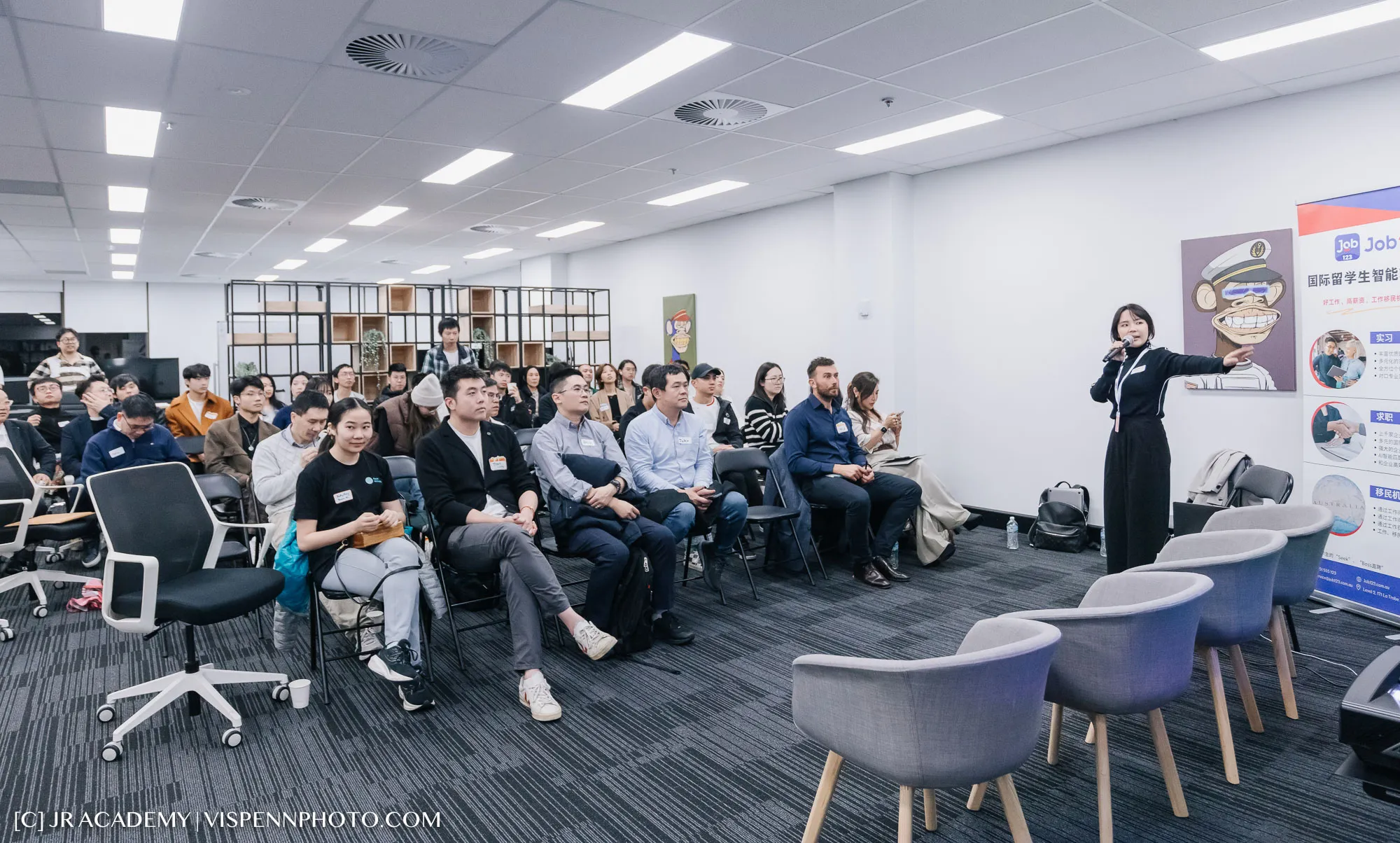
FDE practice brings presentations, questions and hands-on validation together. These photos are from previous JR Academy classes and events.

Observe and participate in weeks 1–2, practise with a guide in weeks 3–4, then own the main project in weeks 5–10. Budget, governance, evaluation and client decisions recur throughout.
Enterprise Discovery
Observe a facilitator-led discovery, map how a company completes a service request, then ask follow-up questions.
Workflow, stakeholder map, evidence and unanswered questions.
Solution Architecture & Commercial Planning
Compare process changes, code automation, RAG and agents; pitch scope, full costs, dependencies and stopping criteria.
Proposal, alternatives, architecture, budget and milestones.
AI Governance & Reliability
Interview business, IT and security roles; turn data residency, access and approval requirements into design and implementation controls.;Build business-reviewed golden data, separate development and acceptance sets, analyse failures and defend the pilot decision.
Data flows, access controls, approvals and technical validation.;Golden dataset, scoring criteria, failure analysis and revised proposal.
Enterprise Engineering
Own discovery for the main project and seek approval for the proposal, budget, acceptance criteria and milestones.;Implement against existing systems; handle least privilege, environment boundaries, duplicate events and long-running work.;Evaluate bounded execution, human takeover and recovery; measure quality, latency and operating costs before changing the implementation.
Project proposal, decision log, budget and acceptance plan.;Working core flow, interface contracts and integration evidence.;Evaluation report, cost and performance evidence, recovery checks.
Stakeholder Leadership
Negotiate budget cuts, interface delays and added requirements; revise scope, architecture, cost and schedule.
Change request, impact analysis, revised proposal and decision log.
Enterprise Adoption
Use baselines and pilot evidence to decide investment; teach users to operate, review and recover the system.;Defend acceptance evidence and individual decisions; let another participant operate and recover the project using the handover pack.
Pilot decision, user instructions, enablement and rollback plan.;Final system, acceptance matrix, runbook, handover pack and pitch.
Start with products these companies describe publicly, then examine their delivery challenges. Classroom extensions introduce budget, data and requirement changes for you to work through.
Enterprise case analysis · ANZ · BANKING
ANZ described Z-GPT in 2023: an internal chatbot using OpenAI models through Microsoft, with experiments on subsets of internal data. Users were responsible for reviewing answers and making the final decision.
Read the official source · ANZ Bluenotes · Z-GPT ↗For a comparable bank assistant, how would you define source access, identity boundaries and answer acceptance criteria?
Start the classroom design with bounded internal Q&A, source checks and human responsibility before considering expansion.
Classroom solution walkthrough
Compare existing enterprise tools, retrieval and custom integrations. Include data governance, integration, evaluation and adoption effort.
Training condition: security rejects a source. Revise the pilot scope and budget recommendation for the sponsor.
Identity and retrieval access checks, version filters, citation and abstention evals, per-request costs and exception logs.
Start with the work and the client’s constraints. Across the cases, data, access and budgets change—and you need to explain how your choice changes with them.
What to validate · Exception ownership and maintainability when rules change.
Revisit APIs, Claude Code, MCP or Skills where you need preparation. Use delivery resources when planning a client pilot. Official page previews and summaries are available here.

Use these courses where you need them. You still need to build and debug AI applications independently before joining.
Recognise model limitations and explain them to users.
Practise delegation, review and developer responsibility.
Consider entry points, features, models and context.
Compare models for a task and its usage limits.
Review APIs, tool calls and agent loops.
Return to these materials when working in a client repository or connecting business systems. Apply what you find in your project.
Explore, plan, implement and check changes in a repository.
Manage permissions and verification for long tasks.
Connect tools and data through MCP.
Package repeatable operations into reusable Skills.
Use the official pilot and adoption guidance when preparing scope, budget, acceptance criteria and handover for the class case.
Qualify a use case, design a pilot and capture a baseline.
Plan user activation, adoption and expansion.
Further reading on production integration.
Further reading on architecture safety and risk.
First-cohort presale · 30 places
Regular course price
Tech is a standalone engineering delivery course. Regular price A$4,800; first-cohort preorder A$4,400; early bird A$4,600. No prior JR Academy AI Engineer purchase is required. Entry depends on engineering skills and project experience.
Consider the course if you already build and debug AI applications independently and want responsibility for enterprise requirements, solutions and delivery.
A separate course · Separate enrolment
Moving towards FDE work from business, product or consulting? Build AI technical fluency, automation practice, discovery, proposals, pitches and client-delivery evidence.
Regular A$3,850 · First-cohort preorder A$3,500 · Early bird A$3,650
Explore FDE BusinessYes. Tech requires the ability to build, debug and explain your own AI applications; purchasing JR Academy AI Engineer first is not required. The two FDE courses also have separate enrolment.
Explore Business first: it builds on domain experience with AI automation, proposals, budgets and cross-team delivery. Tech requires independent AI application development and debugging. Specific gaps in MCP, Skills or other tools can be addressed with official resources.
The current design is 10 weeks, with a 3-hour weekly workshop and around 3–5 hours of project and presentation preparation. Confirm actual cohort dates and session times before enrolment.
Tech requires independent AI implementation. Business is a separate course focused on business judgment, proposals, budgets and adoption. They have separate enrolment. One-to-one coaching addresses an individual background and project.
Use official resources to fill specific gaps in models, APIs, Claude Code, MCP and Skills before class, and consult their pilot and adoption methods during cases. JR Academy organises the main workshops around solution design, implementation, evaluation and customer delivery.
No. A$200,000+ in Australia and US$250,000+ in North America describe career targets. Outcomes depend on experience, skills, interviews and market conditions. The course does not guarantee employment or salary.
Tell us what you do, which AI projects you have built and the roles you want. Discuss fit before deciding whether to enrol.