
Week 1
Business Problems and AI Opportunities
Investigate departmental goals and repetitive work. Use the research exercise to examine sources and qualify a useful workflow.
Stage deliverableProblem definition, workflow and opportunity priorities.

FDE Business · Build on your business experience
Move towards FDE work from business, product or consulting
Bring your business, product or consulting experience into FDE work. Over eight weeks, develop AI technical fluency and practical workflow skills, then apply them to client discovery, solution proposals and delivery.
For business, product, consulting, BA and project professionals preparing to move into FDE roles.
Build on your experience with AI technical fluency, practical workflows, client proposals, pitching and delivery.Already building AI applications independently? Explore FDE Tech
Keep the evidence from discovery through proposal and validation, including failures, revisions and your own contribution.
Document findings, workflows, alternatives, budget and implementation dependencies, including the decision requested.
Connect inputs, processing, review and approvals; record data, permission, exception and engineering dependencies.
Explain your role and decisions using proposals, demonstrations, review changes and handover materials when discussing your project in future applications.
Your background helps you understand clients. FDE work also calls for technically informed proposals and evidence that a solution works. Practise AI workflows, validation and client delivery together.
Build on your business experience over eight weeks: develop AI fluency and automation practice, then connect discovery, proposals, pitches and handover into a client-delivery portfolio.
Investigate departmental goals and repetitive work. Use the research exercise to examine sources and qualify a useful workflow.
Decide what AI, rules and people should handle. Understand document, tool, access and review boundaries.
Use email, PDF and SOP tasks to map inputs, outputs, approvals and exceptions.
Complete an invoice, spreadsheet, quote or content workflow, then verify and revise its outputs.
Connect follow-up, purchasing or onboarding tasks across forms, files and business tools, retaining authorisation, deduplication and human confirmation.
Use payroll, contract and cash-flow reviews to identify missing data, conflicts and calculation issues. Examine repeats and review costs.
Pitch the workflow, validation and proposal to client roles; defend budget, scope, technical dependencies and risks to seek a pilot decision.
Present and hand over the project, explain your own discovery, design, validation and collaboration, and identify gaps against your target FDE role.
Planned over 8 weeks. Confirm cohort dates, weekly contact hours and session times before enrolment.
Use 30 enterprise automation tasks to build hands-on AI fluency. Select tasks for the case, check results and limitations, then connect the workflow to a client proposal, budget and delivery plan.
Use AI to assist with repetitive checks while retaining control of evidence, amounts and approval.
Build a consistent invoice register, check amounts and GST, and flag missing fields for review.
Clean orders, standardise fields and produce summaries through a repeatable spreadsheet workflow.
Reconcile timesheets and pay records, then organise discrepancies for the responsible person to review.
Summarise income and expenses, track balances and surface duplicate, incomplete or inconsistent entries.
Reconcile claims and receipts, flag discrepancies and duplicates, and prepare an approval queue.
Connect information, responses and follow-up while keeping important decisions with people.
Prioritise incoming email, extract actions and owners, and prepare replies grounded in the correspondence.
Prepare quotes with a clear scope, consistent pricing and explicit conditions that need confirmation.
Compare market and competitor information with sources that support a business decision.
Merge customer records, detect duplicates and keep contact permissions and follow-up actions clear.
Organise enquiries into a follow-up queue with missing details, opt-outs and repeated leads handled explicitly.
Route routine questions, missing information and escalations, preparing replies while retaining human decisions on refunds.
Move from document handling to workflows with explicit conditions, owners and exceptions.
Turn business PDFs into editable documents, process tables and action lists that colleagues can use.
Map business information to form fields, check gaps and formatting, and reduce repetitive data entry.
Turn scattered process notes into an SOP with owners, checks and clear exception handling.
Extract key dates, amounts and responsibilities from contracts, then identify questions for professional review.
Organise files in bulk with names, folders and an index that other team members can follow.
Schedule a verified recurring task with duplicate handling, failure notifications and human checkpoints.
Connect purchase requests, quotes, costs and approvers, and prepare review packs for incomplete or over-budget requests.
Compare supplier pricing, services and mandatory requirements, explaining a recommendation without filling unknowns.
Check stock, reservations and data freshness, calculate a reorder recommendation and retain owner review.
Route document requests through public responses, purpose clarification or access review with the correct owner.
Check failed runs, repeats and cost overruns, reconciling uncertain outcomes before retrying or handing over.
Turn meeting, people and project information into work with clear ownership and follow-through.
Turn recordings and notes into summaries, decisions and actions while keeping unresolved questions visible.
Check interview times, timezones and availability, resolve conflicts and prepare coordination messages.
Organise onboarding tasks with owners and dependencies, including information, access approval and handover.
Turn meeting discussions into actionable plans, distinguishing suggestions from decisions and clarifying owners and dates.
Use project evidence to report progress, blockers and the decisions required from the delivery lead.
Create and revise useful content from the business information you already have.
Create and revise promotional graphics, checking copy, brand consistency and the underlying business information.
Turn event and product information into video topics, scripts and storyboards with a clear factual basis.
Prepare social copy and page-by-page content, checking facts, tone and the decisions needed before publication.
Start with work you know. Build an output, connect related tasks and practise explaining requirements, exceptions and costs to colleagues and technical teams.
Choose from 30 tasks for your role; classroom practice and presentations focus on selected workflows.
Start with a company brief and guided discovery. Develop your own proposal and workflow validation, pitch to participants acting as business, IT and budget owners, then revise your work after review.
Establish the problem, decision-makers, facts and assumptions to verify.
People in the room · Business owner / end users
Explain your individual investigation, validation and decisions. Use the 30 automation tasks to build practical fluency and apply it within client delivery cases.
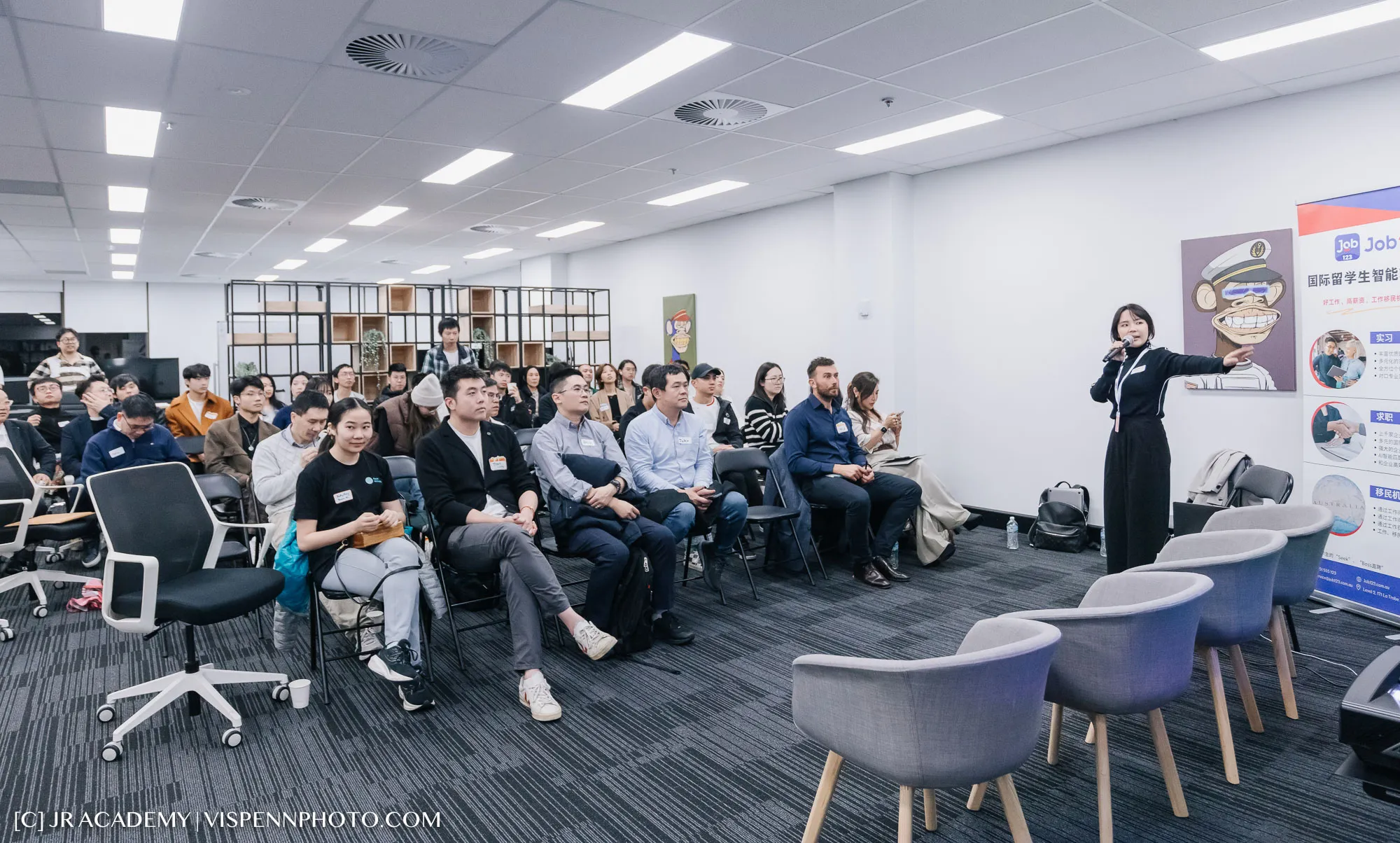
FDE practice brings presentations, questions and hands-on validation together. These photos are from previous JR Academy classes and events.

Build on your business experience over eight weeks: develop AI fluency and automation practice, then connect discovery, proposals, pitches and handover into a client-delivery portfolio.
Business Problems and AI Opportunities
Investigate workflows and user problems. Compare AI, rules and process changes.
Problem analysis, workflow map, priorities and assumptions.
AI Fluency for Decision-Makers
Understand model limits, data, retrieval, tool calls, access and human review.
Business requirements, dependencies and a risk register.
Designing AI Workflows
Use email, PDF and SOP tasks to define triggers, inputs, steps, approvals and exceptions. Choose the roles of AI, rules and people and estimate dependencies.
Workflow map, input/output rules, approval points and scope.
Building AI Automations
Choose invoice, Excel, quote, customer-data or content tasks. Use Codex with files, verify outputs and connect form, file and recurring workflows.
Complete outputs, a connected workflow and work records.
Testing and Improving Automations
Check omissions, conflicts, calculations, duplicate execution and human takeover. Record revisions and review costs for budget and stakeholder decisions.
Exception log, revisions, costs and review evidence.
AI Adoption and Business Value
Establish a baseline and acceptance criteria. Plan first users, measurement and ongoing ownership.
Pilot plan, measures, user adoption and ownership.
Start with products these companies describe publicly, then examine their delivery challenges. Classroom extensions introduce budget, data and requirement changes for you to work through.
Enterprise case analysis · ANZ · BANKING
ANZ described Z-GPT in 2023: an internal chatbot using OpenAI models through Microsoft, with experiments on subsets of internal data. Users were responsible for reviewing answers and making the final decision.
Read the official source · ANZ Bluenotes · Z-GPT ↗For a comparable bank assistant, how would you define source access, identity boundaries and answer acceptance criteria?
Start the classroom design with bounded internal Q&A, source checks and human responsibility before considering expansion.
Classroom solution walkthrough
Compare existing enterprise tools, retrieval and custom integrations. Include data governance, integration, evaluation and adoption effort.
Training condition: security rejects a source. Revise the pilot scope and budget recommendation for the sponsor.
Data ownership and access boundaries, a phased business case, budget and acceptance criteria, and an engineering integration brief.
Start with the work and the client’s constraints. Across the cases, data, access and budgets change—and you need to explain how your choice changes with them.
What to validate · Exception ownership and maintainability when rules change.

JR Academy founder
Startup experience, full-stack development and product design.

Former Googler SDE · Block SDE
Former Google software engineer (SDE), with SDE experience at Block; also mentors in software engineering and careers.

FDE experience · V2
Forward Deployed Engineer experience at V2 and an AI Engineer VIP mentor, supporting AI engineering projects and technical mentoring.

FDE experience · V2
Forward Deployed Engineer experience at V2, with a focus on applied AI and AI engineering and a software engineering background.
Confirm the teaching and project guidance arrangements when enquiring.
Understand AI limitations, then refer to official pilot and adoption guidance while developing your own proposal and validation.

Build AI literacy and review results before treating them as business conclusions.
Understand limitations and common failures.
Practise delegation and output review.
Refer to baseline, acceptance, first-user and internal ownership guidance.
Design a pilot that answers a business question.
Plan activation, enablement and adoption.
First-cohort presale · 30 places
Business regular price
Eight-week standalone course: regular A$3,850, first-cohort preorder A$3,500, early bird A$3,650. For business, product, consulting and project professionals moving towards FDE; no prior AI Engineer or Tech purchase is required.
Bring business, product, consulting, BA or project experience and a willingness to build and validate. Identify your technical gaps. If you already develop AI applications independently, compare the Tech engineering delivery course.
A separate course · Separate enrolment
For engineers who already build AI applications and want to implement enterprise systems. The two courses have separate enrolment, prerequisites and assignments.
Regular A$4,800 · First-cohort preorder A$4,400 · Early bird A$4,600
Explore FDE TechYes. Develop AI fluency, workflows, validation and client proposals through hands-on work. Roles requiring independent application development, systems integration and production operations also require further AI Engineering capability. Compare your target role requirements before choosing.
Practise discovery, alternatives, budgeting, workflow validation and pitching across cases. Keep individual contribution, review revisions and handover evidence to explain your delivery skills and identify remaining gaps. Employment and salary outcomes are not guaranteed.
Regular A$3,850; first-cohort preorder A$3,500 (A$350 below regular); early bird A$3,650 (A$200 below regular). All cover the same eight-week course, with eligibility based on the enrolment stage. Confirm stage dates when enquiring.
Business is planned over 8 weeks, using multiple cases for practical tasks, proposals and presentations. Confirm cohort dates, weekly contact hours and session times before enrolment.
Both develop FDE responsibilities. Business builds AI fluency, automation practice and client delivery on business, product and consulting experience. Tech starts with independent AI application development and goes deeper into integration, evaluation, reliability and operations. Choose for your starting point and target role; enrolment is independent.
Business uses shared class cases for proposals, validation and presentations. One-to-one guidance considers an individual background and project and is a separate offering.
Discuss your previous projects, target FDE responsibilities and current AI experience to assess your starting point and fit.