
AI and ML Engineer Certifications in 2027: Which to Take?
Choose an AI certification for application development, ML engineering or architecture. Compare AWS, Azure, Google Cloud and Claude exam costs, experience expectations and eligibility, with routes for developers and career changers.
Contents
- Choose the work before choosing the exam
- How the foundation, builder and professional routes fit together
- Exam costs and entry expectations
- Check the AWS version before buying study materials
- Check Claude eligibility before planning an exam date
- A path for your current background
- Graduate or career changer
- Backend developer moving into RAG and agents
- Data scientist or cloud engineer moving into MLOps
- Experienced engineer taking architecture responsibility
- Select a route
- What should accompany the certification on your CV?
- Common certification questions
- Which AI certification should a beginner get?
- Can an experienced developer skip a foundational exam?
- Should I get AWS, Azure and Google Cloud certifications?
- Does a Claude Academy badge count as professional certification?
- How long should I allow for preparation?
- Is a certification enough to apply for an AI engineering role?
- Start with a guide and question bank
For a software developer moving into AI applications, compare Azure AI-103 with Claude Developer Foundations. For work involving model deployment and ML pipelines, look at the engineering certification for your cloud platform, such as Google Cloud Professional Machine Learning Engineer. If you are still learning AI concepts and service selection, AWS AI Practitioner is a foundational option.
Exam facts were checked on 25 November 2026. This is a guide for planning your 2027 studies. Confirm the exam version, language and local booking price before paying.
Choose the work before choosing the exam
An AI engineer job description can involve integrating a model into a product, operating a training pipeline, or designing an enterprise system. When looking for roles in Australia, the US or Canada, read the responsibilities and named technologies as closely as the job title. Use those requirements to narrow your certification choice.
| Work you want to own | What to practise | Certifications to compare |
|---|---|---|
| Add document search and tool use to a business application | API integration, retrieval, permissions, evaluation and failure handling | AI-103, Claude Developer Foundations |
| Train, deploy and operate models | Data preparation, evaluation, pipelines, endpoints and monitoring | AWS ML Engineer version guide, Google Cloud ML Engineer |
| Design an AI system and lead delivery | Architecture decisions, reliability, integration and governance | Claude Architect Foundations, Claude Architect Professional |
| Use AI in an existing business workflow | Concepts, product selection and checking outputs | AWS AI Practitioner, Claude Associate Foundations |
These recommendations follow the differences in the official exam scopes. Review the Microsoft study guide, AWS ML outline, Google exam guide and Anthropic role descriptions against the work you want to do.
How the foundation, builder and professional routes fit together
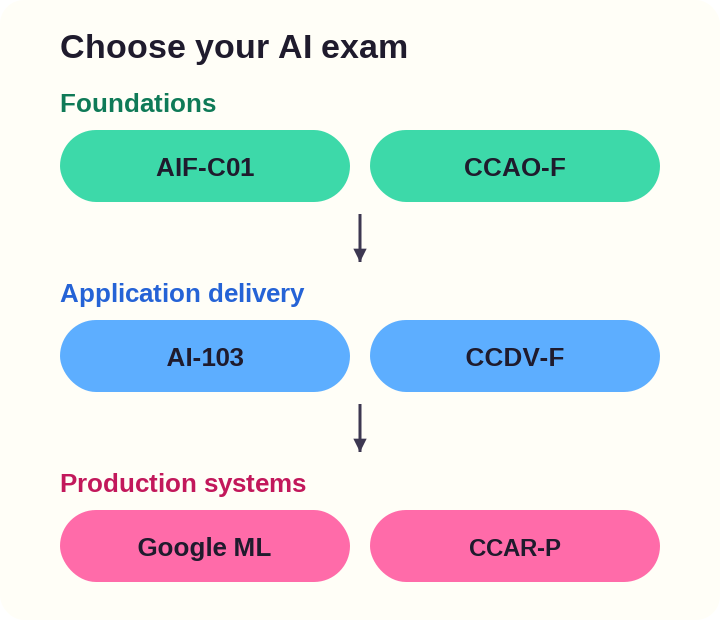
Use foundations to close gaps in concepts and service selection. Move into an application exam when you can build and debug software. Choose a professional route when you have experience with the production decisions it covers. You can start at the level that matches your experience, subject to the provider's eligibility rules.
Exam costs and entry expectations
The amounts below are published US-dollar exam fees, checked on 25 November 2026. Taxes, discounts and regional prices may affect checkout. Recommended experience helps you judge the preparation required.
| Credential and level | Suitable starting point | Published exam fee | Exam time | Official source |
|---|---|---|---|---|
| AWS AI Practitioner, Foundational | Learning AI concepts and AWS service selection | US$100 | 90 minutes | AWS exam page |
| Azure AI-103, Intermediate | Python development and Azure AI applications | Check the country or region of examination | 120 minutes | Microsoft exam page |
| AWS MLA-C01, Associate | Existing AWS ML experience; remaining non-English exam appointments | US$150 | 130 minutes | AWS exam page |
| AWS MLA-C02, Associate Beta | Operating ML and generative AI on AWS | US$75 Beta price | 170 minutes for Beta | AWS update |
| Google Cloud ML Engineer, Professional | Experience deploying cloud ML systems | US$200 plus applicable tax | 120 minutes | Google exam page |
| Claude Associate Foundations | Business and productivity workflows | US$99 | 120 minutes | Official guide, section 5 |
| Claude Developer Foundations | Software development and hands-on LLM applications | US$125 | 120 minutes | Official guide, section 5 |
| Claude Architect Foundations | Agent design and tool integration | US$125 | 120 minutes | Official guide, section 3 |
| Claude Architect Professional | End-to-end AI architecture and governance | US$175 | 120 minutes | Official guide, section 5 |
Check the AWS version before buying study materials
The English MLA-C01 exam ended on 28 September 2026. AWS has announced general availability of MLA-C02 for 14 January 2027, when the remaining language versions of the old exam retire. For an English-language exam, use the current registration information and the new outline. The Beta fee and duration in the table apply to Beta bookings. AWS transition announcement
The new outline covers traditional ML alongside foundation models and agentic workflows. Check older materials against the current task statements before using them for a 2027 study plan. AWS MLA-C02 guide
Check Claude eligibility before planning an exam date
Pearson describes the certification program as open to organisations in the Claude Partner Network, with scheduling starting in Partner Academy. Confirm access through your organisation before paying for exam preparation. Pearson registration information
Among the four routes covered here, Associate Foundations targets business use, Developer Foundations targets application delivery, Architect Foundations targets agent-system design, and Architect Professional covers enterprise architecture and governance. Choose by responsibility. Anthropic role overview
A path for your current background
Graduate or career changer
Start by checking whether you can call an API, inspect JSON, handle authentication errors and explain how data moves through your application. If those tasks are unfamiliar, combine programming practice with the concepts in AWS AI Practitioner.
Build a document question-answering application that retains the retrieved passages. Test questions that lack an answer in the source material and inspect what the system does. Once you can debug that workflow, use a technical exam outline to identify the next gaps in your knowledge.
Backend developer moving into RAG and agents
Your existing experience with APIs, databases and tests gives you a useful starting point. Add retrieval and a restricted tool to an application, then handle timeouts and repeated requests. Keep an evaluation set you can rerun after changes.
For Microsoft Foundry work, examine AI-103. If you have Claude application experience and can access the certification program, consider Developer Foundations. Compare Architect Foundations when your responsibilities extend to agent orchestration and tool-interface design.
Data scientist or cloud engineer moving into MLOps
Practise running a repeatable training workflow, deploying the result and identifying failures after deployment. A notebook experiment leaves several engineering tasks to work through before production operation.
Study the current AWS version for AWS work, using the ML Engineer guide to understand the old-version boundary. For Google Cloud, Professional Machine Learning Engineer has no mandatory prerequisites. Google recommends three or more years of industry experience, including a year designing and managing Google Cloud solutions. Use that recommendation to assess your readiness. Google experience guidance
Experienced engineer taking architecture responsibility
Prepare a design you can defend. Explain access boundaries, evaluation criteria, escalation and operational monitoring. Claude Architect Professional is an option for that responsibility. Its guide lists no mandatory prerequisite, so taking Architect Foundations first is a study choice based on your gaps. Professional exam guide, section 4
Select a route
Use the selector for AWS foundations, Google ML or Claude technical work. For Azure applications, open the AI-103 guide. The sequences below are learning recommendations.
Certification path finder
- AWS AI Practitioner
Use the foundational outline to learn AI concepts, then check your understanding through a small project.
What should accompany the certification on your CV?
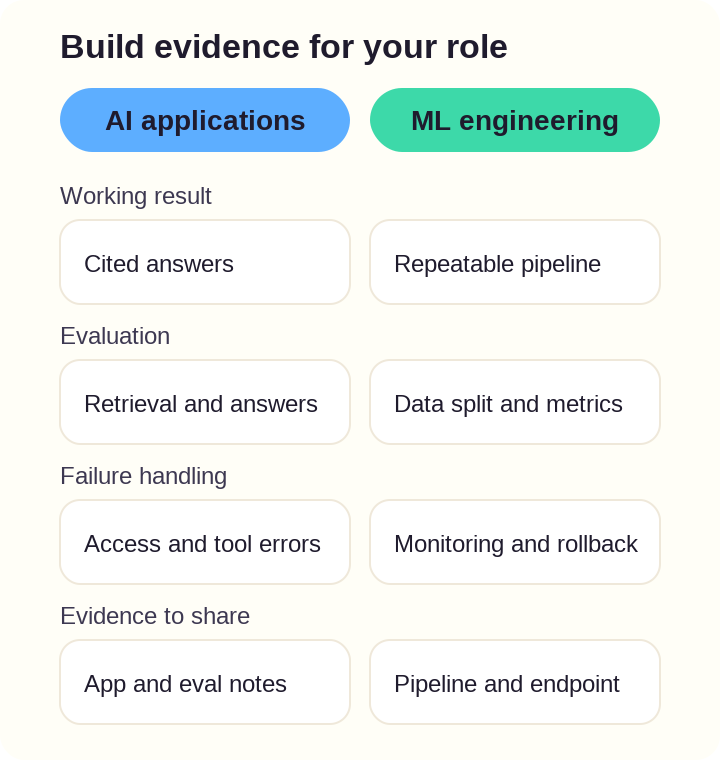
For an application role, provide a working document-search application with visible source references. Include evaluation inputs, failure cases and an explanation of tool permissions. For an ML engineering role, provide a repeatable pipeline and explain the data split, chosen metrics, deployment and rollback. For architecture work, add a design document showing why the access and reliability decisions fit the requirements.
Describe the work you actually completed and link to an inspectable result. You can compare the skills in the AI engineer career map, ML engineer map and MLOps map with the responsibilities in your target roles.
For structured study, review the scope of AI Engineer self-paced learning, AI Engineer Bootcamp or RAG to Agent training before choosing a course.
Common certification questions
Which AI certification should a beginner get?
AWS AI Practitioner is one option for AI concepts and AWS service selection. Pair it with programming practice if you want an engineering role, and compare technical exam objectives once you have a working application.
Can an experienced developer skip a foundational exam?
Start with a gap check against the target outline. If the concepts are familiar, focus your study on the technical work in AI-103 or Claude Developer Foundations, after checking the provider's eligibility rules.
Should I get AWS, Azure and Google Cloud certifications?
Choose a platform you can practise on and compare it with your target job descriptions. Add another platform when you have a reason to use it and can demonstrate the relevant work.
Does a Claude Academy badge count as professional certification?
Academy completion badges come from course quizzes. The certification program uses separate paid, proctored exams. Check the Claude certification guide for the routes and confirm your eligibility. Academy FAQ
How long should I allow for preparation?
Separate the exam tasks into work you have done, topics you need to revisit and tasks you need to learn through practice. Estimate time for each group, then plan around your available study hours. Use the certification guide's schedule as a starting point.
Is a certification enough to apply for an AI engineering role?
Use the job requirements to decide what evidence to submit. Alongside an earned credential, include a project that shows your implementation, evaluation and deployment decisions. Describe your own contribution clearly.
Start with a guide and question bank
Read the certification guide to check the current scope before booking. For foundational study, open the AWS AI Practitioner question bank. For Claude application development, use the Developer Foundations question bank and review the explanations against the areas you need to practise.