匠人学院 JR Academy

FOR DATA ANALYSTS MOVING INTO DATA ENGINEERING

AI Data EngineerPractical Project Sprint

You can query data. Start learning to build the pipeline.

Follow one retail project from data modelling and reliable pipelines to churn modelling and AWS batch scoring. AI helps draft and debug; you run, verify and modify the work.

Proposed: two weeks · four guided sessions · three hours each, including breaks

2 weeksProposed pace
4 × 3hGuided sessions · breaks included
DA → DESQL + basic Python

Course preview · schedule to be confirmed

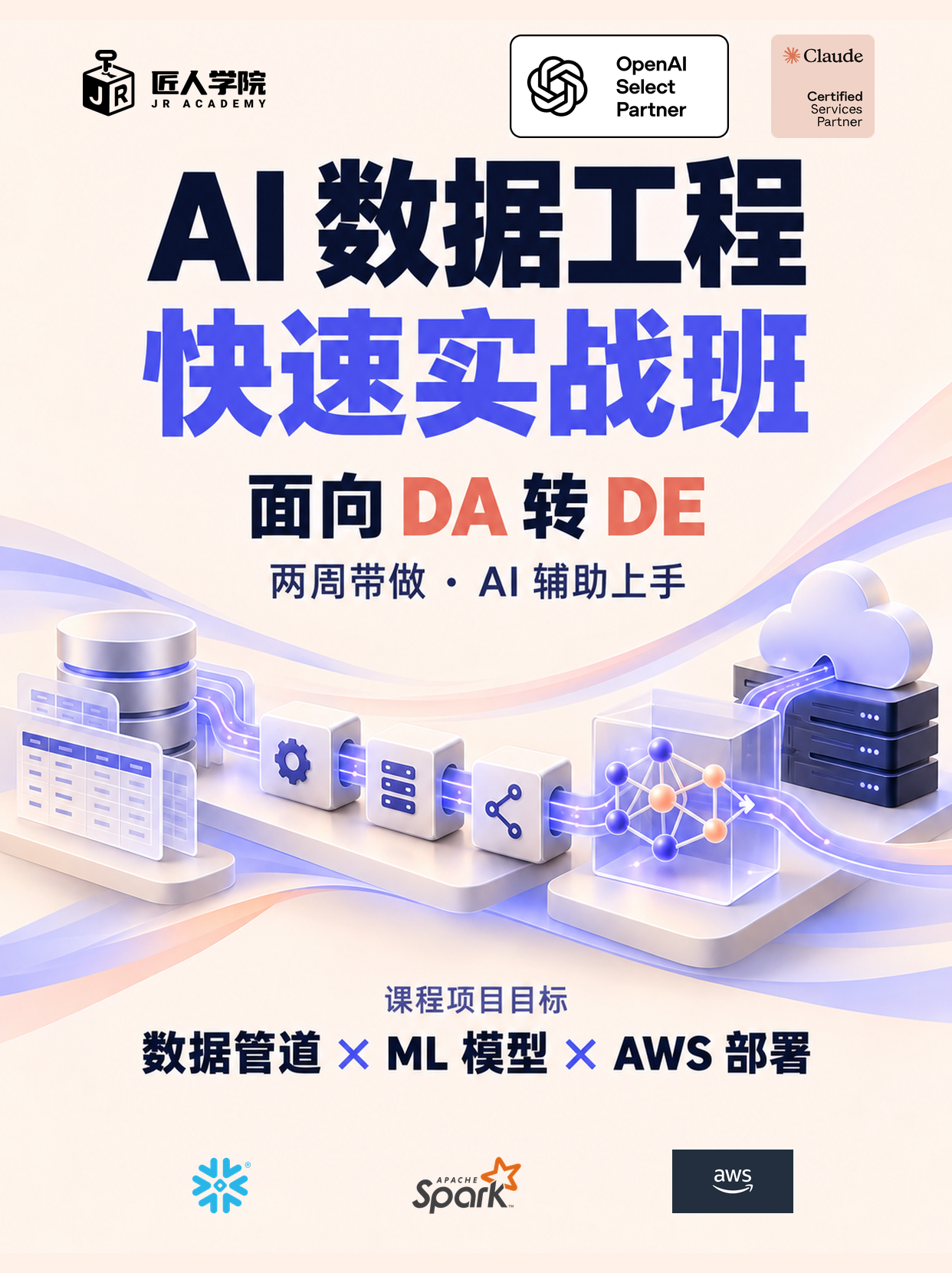
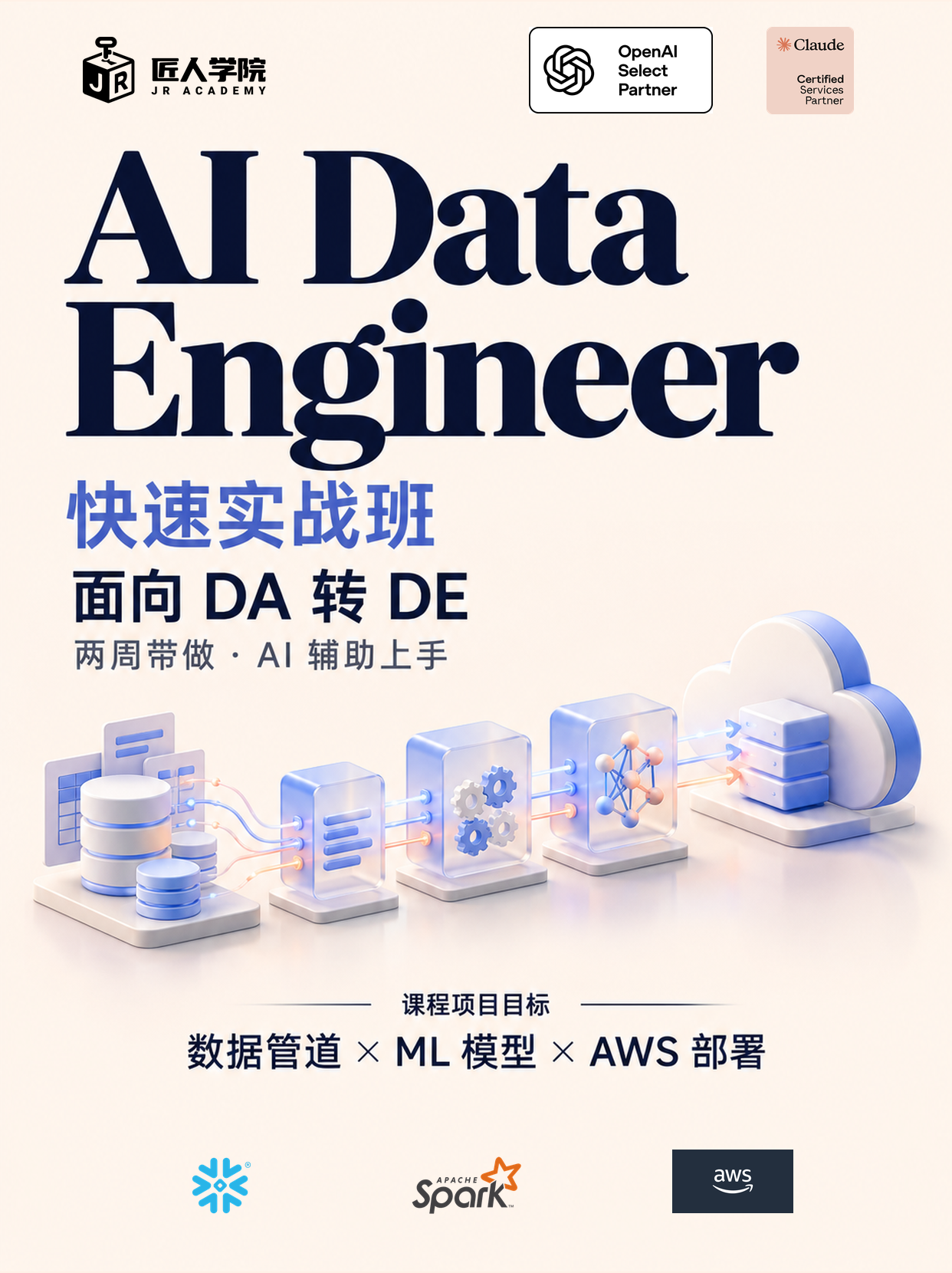
AI Data Engineer project sprint for DA to DE, with data pipelines, an ML model and AWS deployment as course project goals. Chinese campaign artwork.
JR Academy partner credentials
OpenAI Select PartnerClaude Certified Services Partner

ONE PROJECT · THREE DELIVERABLES

The project you will work towards

Prepare reliable sales metrics and customer churn scores. Connect raw data, model inputs and repeatable processing and scoring tasks.

Open the completed local referencePython / SQLite · complete readable source
Project stage / 01

Data pipeline

Reliable inputs from raw data

Snowflake layers, dbt models and tests, PySpark transformations, incremental updates and failure checks.

Target deliverables
  • dbt models
  • PySpark job
  • Data tests
Project stage / 02

Customer churn model

A model built on customer data

Historical snapshots, features and labels, a training notebook, leakage checks, evaluation and a saved model.

Target deliverables
  • Training notebook
  • Model artifact
  • Evaluation report
Project stage / 03

AWS batch data product

Processing and scoring as a batch workflow

S3 and Glue, Snowflake features, SageMaker batch scoring, Step Functions orchestration and CloudWatch records.

Target deliverables
  • Batch Scoring
  • Step Functions
  • CloudWatch logs
Course project goals

These are course project goals. Complete Snowflake, Spark, ML and AWS reference outputs are still being prepared.

RETAILFLOW / SYSTEM DESIGN

From Data Pipeline to Batch Prediction

Three workflows connect data preparation, model training and batch prediction. AI assists with code, debugging and code review; you validate the results.

Step FunctionsControl Flow: orchestrate processing and scoring tasks, including retry and failure handling.
01

Data Pipeline

S3 · Batch Input
Glue / PySpark
Snowflake · Bronze → Silver → Gold
Feature Dataset

dbt models and tests handle Snowflake transformations and data quality. The feature dataset feeds both training and batch scoring.

02

Model Training

Historical Snapshots
Features + Labels
scikit-learn · Train & Evaluate
S3 · Model Artifact

Build historical features and labels from the feature dataset, check data leakage, then evaluate and save a model artifact for Batch Transform.

03

Batch Scoring

S3 · Feature Export
SageMaker Batch Transform
S3 · Prediction Output

Export features to S3. Batch Transform reads the feature export and model artifact, then writes prediction files to S3.

CloudWatchObservability: collect processing, training and batch-scoring logs, metrics and alerts.
Data FlowOrchestrationLogs & Alerts

Planned course architecture. Open the executed Python / SQLite reference →

RETAILFLOW / LOCAL REFERENCE

Open the completed data-processing reference

RetailFlow orders: additions and cancellations change revenue from A$150 to A$130. Re-running a batch preserves the result; a missing product blocks publication.

First batch: deduplicated

Checks passed

Revenue AUD150.00
Valid orders2
Units sold4
Average order value AUD75.00

Duplicate O100-L1 is removed; three valid lines belong to two orders.

What this reference verifies

  • Duplicate line removed
  • Cancellation applied
  • Repeated batch unchanged
  • Older status ignored
  • Missing product blocks publication
  • Rollback retains valid result

Reference scope: one business date and fixed AUD. Same-key line changes, equal-timestamp precedence, taxes and refunds are not implemented. No scheduling, cloud or live AI execution.

Read the complete source, inputs and results

Download the source and inputs and follow the README to reproduce the calculation locally. This page shows precomputed outputs.

README.md
# RetailFlow local reference

Synthetic, pre-generated teaching reference. Run `python3 pipeline.py --output result.json` using Python 3 with its standard library. No installation, network, API key, AI call, cloud account or charge is needed.

`orders-batch-1.csv` and `lines-batch-1.csv` produce AUD 150 revenue, 2 orders, 4 units and AUD 75 average order value after duplicate line removal. Batch 2 cancels O101 and adds O102, producing AUD 130, 2 orders, 4 units and AUD 65 average order value. Repeating batch 2 leaves the result unchanged. An older O101 paid status cannot override the cancellation. A deliberately injected P999 line must fail validation; it is rolled back and the last valid result is retained.

The SQL models and Python runner are the complete implementation of this small SQLite reference. The course's planned Snowflake/dbt models, cloud permissions, scheduler and AI workflow are not implemented here. This is not a production platform or a finished implementation of every course outcome.

Scope: a single predefined business date, fixed AUD, current-value product categories, immutable line keys. Changed existing line amounts, equal-timestamp conflicts, full source reconciliation, tax/refund accounting, multiple dates, concurrency and production access controls are outside this reference. Explain these limitations when presenting the project.

Ownership: course reference template. A learner must add and verify their own change before describing personal contributions. Do not present the reference as real client work, real learner work, or measured career outcomes.
Open file
pipeline.py
"""RetailFlow local reference: stdlib SQLite, synthetic data, no cloud/API calls.
Run: python3 pipeline.py --output result.json
This validates the teaching logic, not the planned Snowflake/dbt implementation.
"""
import argparse
import csv
import json
import sqlite3
from pathlib import Path

ROOT = Path(__file__).resolve().parent


def execute():
    db = sqlite3.connect(':memory:')
    db.row_factory = sqlite3.Row
    db.executescript((ROOT / 'models.sql').read_text())

    def load_orders(filename):
        for row in csv.DictReader((ROOT / filename).open()):
            db.execute('''INSERT INTO orders VALUES (:order_id,:status,:updated_at)
                ON CONFLICT(order_id) DO UPDATE SET status=excluded.status,
                updated_at=excluded.updated_at WHERE excluded.updated_at > orders.updated_at''', row)

    def load_lines(filename):
        for row in csv.DictReader((ROOT / filename).open()):
            db.execute('''INSERT INTO lines VALUES (:order_id,:line_id,:product_id,:quantity,:unit_price)
                ON CONFLICT(order_id,line_id) DO NOTHING''', row)

    def validate():
        missing = db.execute('''SELECT l.order_id,l.line_id,l.product_id FROM lines l
            LEFT JOIN products p USING(product_id) WHERE p.product_id IS NULL''').fetchall()
        if missing:
            raise ValueError('Missing product reference: ' + json.dumps([dict(r) for r in missing]))
        invalid = db.execute('SELECT COUNT(*) FROM lines WHERE quantity<=0 OR unit_price<0').fetchone()[0]
        if invalid:
            raise ValueError('Invalid quantity or unit price')

    def snapshot():
        validate()
        row = dict(db.execute('SELECT * FROM daily_sales').fetchone())
        row['order_count'] = int(row['order_count'])
        return row

    db.executemany('INSERT INTO products VALUES (?,?)', [('P100','Accessories'),('P101','Stationery'),('P102','Home')])
    load_orders('orders-batch-1.csv')
    load_lines('lines-batch-1.csv')
    first = snapshot()
    assert first['revenue'] == 150 and first['order_count'] == 2 and first['units'] == 4
    load_orders('orders-batch-2.csv')
    load_lines('lines-batch-2.csv')
    second = snapshot()
    assert second['revenue'] == 130 and second['aov'] == 65
    load_orders('orders-batch-2.csv')
    load_lines('lines-batch-2.csv')
    repeated = snapshot()
    assert second == repeated
    load_orders('orders-late.csv')
    assert snapshot() == second, 'Older paid status must not overwrite latest cancellation'
    db.execute('SAVEPOINT invalid_batch')
    db.execute("INSERT INTO lines VALUES ('O102','L2','P999',1,99)")
    try:
        snapshot()
    except ValueError as error:
        failure = str(error)
    else:
        raise AssertionError('Missing product should block result publication')
    db.execute('ROLLBACK TO invalid_batch')
    restored = snapshot()
    assert restored == second
    return {
        'evidence': 'Executed local SQLite reference; synthetic data; no Snowflake/dbt or scheduler validation',
        'business_date': '2026-10-01',
        'currency': 'AUD',
        'stages': [
            {'id':'first','label':'第一批:完成去重','status':'passed','result':first,
             'explanation':'重复的 O100-L1 只保留一次,三条有效明细对应两个订单。'},
            {'id':'second','label':'第二批:更新与取消','status':'passed','result':second,
             'explanation':'O101 最新状态变为 cancelled,移出 A$50;O102 新增 A$30。'},
            {'id':'repeat','label':'同批重跑','status':'passed','result':repeated,
             'explanation':'第二批再次执行,业务结果与上次完全一致;更旧的 paid 状态也不会覆盖取消。'},
            {'id':'failure','label':'异常批次:阻止发布','status':'blocked','result':restored,
             'explanation':'P999 不存在,检查失败,异常批次回滚;这里显示上一次有效结果,不是本次新结果。','error':failure},
        ],
        'checks': [
            {'name':'Duplicate line removed','status':'passed'},
            {'name':'Cancellation applied','status':'passed'},
            {'name':'Repeated batch unchanged','status':'passed'},
            {'name':'Older status ignored','status':'passed'},
            {'name':'Missing product blocks publication','status':'passed'},
            {'name':'Rollback retains last valid result','status':'passed'},
        ],
        'limitations': ['One business date; fixed AUD; no tax/refund accounting',
                         'Line changes with the same key are outside this reference implementation',
                         'Equal update timestamps require a defined tie-breaker in the course implementation',
                         'No cloud, AI execution, scheduling, or production deployment demonstrated'],
    }


if __name__ == '__main__':
    parser = argparse.ArgumentParser()
    parser.add_argument('--output', type=Path, default=ROOT / 'result.json')
    args = parser.parse_args()
    args.output.write_text(json.dumps(execute(), ensure_ascii=False, indent=2) + '\n')
    print('Local reference executed: 6 checks passed; wrote', args.output)
Open file
models.sql
CREATE TABLE products(product_id TEXT PRIMARY KEY, category TEXT NOT NULL);
CREATE TABLE orders(order_id TEXT PRIMARY KEY, status TEXT NOT NULL, updated_at TEXT NOT NULL);
CREATE TABLE lines(
    order_id TEXT NOT NULL REFERENCES orders(order_id), line_id TEXT NOT NULL,
    product_id TEXT NOT NULL, quantity INTEGER NOT NULL, unit_price REAL NOT NULL,
    PRIMARY KEY(order_id,line_id)
);
-- One-date reference. All synthetic orders belong to 2026-10-01 Brisbane time.
-- The course Snowflake/dbt implementation must derive the business date explicitly.
CREATE VIEW valid_lines AS
SELECT l.*, p.category FROM lines l JOIN orders o USING(order_id)
JOIN products p USING(product_id) WHERE o.status IN ('paid','completed');
CREATE VIEW daily_sales AS
SELECT ROUND(COALESCE(SUM(quantity*unit_price),0),2) AS revenue,
       COUNT(DISTINCT order_id) AS order_count,
       COALESCE(SUM(quantity),0) AS units,
       ROUND(SUM(quantity*unit_price)/NULLIF(COUNT(DISTINCT order_id),0),2) AS aov
FROM valid_lines;
Open file
orders-batch-1.csv
order_id,status,updated_at
O100,paid,2026-10-01T00:00:00Z
O101,paid,2026-10-01T00:05:00Z
Open file
lines-batch-1.csv
order_id,line_id,product_id,quantity,unit_price
O100,L1,P100,2,40
O100,L1,P100,2,40
O100,L2,P101,1,20
O101,L1,P102,1,50
Open file
orders-batch-2.csv
order_id,status,updated_at
O101,cancelled,2026-10-02T00:00:00Z
O102,paid,2026-10-02T00:01:00Z
Open file
lines-batch-2.csv
order_id,line_id,product_id,quantity,unit_price
O102,L1,P100,1,30
Open file
orders-late.csv
order_id,status,updated_at
O101,paid,2026-10-01T00:05:00Z
Open file
result.json
{
  "evidence": "Executed local SQLite reference; synthetic data; no Snowflake/dbt or scheduler validation",
  "business_date": "2026-10-01",
  "currency": "AUD",
  "stages": [
    {
      "id": "first",
      "label": "第一批:完成去重",
      "status": "passed",
      "result": {
        "revenue": 150.0,
        "order_count": 2,
        "units": 4,
        "aov": 75.0
      },
      "explanation": "重复的 O100-L1 只保留一次,三条有效明细对应两个订单。"
    },
    {
      "id": "second",
      "label": "第二批:更新与取消",
      "status": "passed",
      "result": {
        "revenue": 130.0,
        "order_count": 2,
        "units": 4,
        "aov": 65.0
      },
      "explanation": "O101 最新状态变为 cancelled,移出 A$50;O102 新增 A$30。"
    },
    {
      "id": "repeat",
      "label": "同批重跑",
      "status": "passed",
      "result": {
        "revenue": 130.0,
        "order_count": 2,
        "units": 4,
        "aov": 65.0
      },
      "explanation": "第二批再次执行,业务结果与上次完全一致;更旧的 paid 状态也不会覆盖取消。"
    },
    {
      "id": "failure",
      "label": "异常批次:阻止发布",
      "status": "blocked",
      "result": {
        "revenue": 130.0,
        "order_count": 2,
        "units": 4,
        "aov": 65.0
      },
      "explanation": "P999 不存在,检查失败,异常批次回滚;这里显示上一次有效结果,不是本次新结果。",
      "error": "Missing product reference: [{\"order_id\": \"O102\", \"line_id\": \"L2\", \"product_id\": \"P999\"}]"
    }
  ],
  "checks": [
    {
      "name": "Duplicate line removed",
      "status": "passed"
    },
    {
      "name": "Cancellation applied",
      "status": "passed"
    },
    {
      "name": "Repeated batch unchanged",
      "status": "passed"
    },
    {
      "name": "Older status ignored",
      "status": "passed"
    },
    {
      "name": "Missing product blocks publication",
      "status": "passed"
    },
    {
      "name": "Rollback retains last valid result",
      "status": "passed"
    }
  ],
  "limitations": [
    "One business date; fixed AUD; no tax/refund accounting",
    "Line changes with the same key are outside this reference implementation",
    "Equal update timestamps require a defined tie-breaker in the course implementation",
    "No cloud, AI execution, scheduling, or production deployment demonstrated"
  ]
}
Open file

For analysts ready to start building data systems

Your starting point

DA, BI or reporting experience; SQL JOIN and GROUP BY; basic Python reading. Check Git and terminal skills before class.

How you get started quickly

One project, prepared starter environments and checkpoints. AI helps draft; sessions focus on the key engineering steps.

Your own contribution

Change a metric, feature or quality rule. Keep the expected output, code difference and verification, and explain your decisions.

CURRICULUM / 4 GUIDED SESSIONS

Four sessions, one connected project

All five teacher modules remain: roles, warehouses and lakes, ML, Snowflake/Spark, and data products with AWS. Each session includes a ten-minute break. Preparation and homework are additional.

Before the first session

Allow a proposed 60–90 minutes to check SQL, Python, Git and terminal basics. Snowflake, notebooks, historical snapshots, AWS sandbox and templates must be prepared and rehearsed before teaching; access and credits remain unconfirmed.

Session two uses provided historical snapshots. Newly loaded orders are not treated as already-observed churn labels. Teaching order differs from the production batch dependency order.

L01 / 180 MIN

1. From analysis to architecture: model and load data

Define retail order grain and a star schema, plan Bronze/Silver/Gold layers, and load the first Snowflake batch.

What you submit

  • Star schema and three-layer architecture
  • Data dictionary, business keys and data contract
  • Snowflake load SQL and verification

AI assistance and your verification

AI drafts DDL and model notes; you verify grain, joins and amount definitions.

What you need first

Existing SQL skills; prepared CSV inputs and Snowflake environment.

Open the teaching schedule
  1. 0–15 min

    Review the project goal and distinguish available evidence from planned outputs

  2. 15–35 min

    DA/DE/DS responsibilities and hand-offs

  3. 35–60 min

    OLTP/OLAP, warehouse/lake/lakehouse, Iceberg/Delta and SCD2 boundaries

  4. 60–90 min

    AI-assisted star schema and layers; inspect grain, keys and amounts

  5. 90–100 min

    Break

  6. 100–145 min

    Run DDL, stage and COPY INTO in a prepared Snowflake environment; validate CSV loads

  7. 145–170 min

    Use a reference transformation to create customer inputs; check types, fields and prediction time

  8. 170–180 min

    Record the data contract and inputs for the next session

Project requirements and follow-up work

Key concepts and operations

  • Explain DA, DE and DS hand-offs
  • Design fact/dimension tables around grain and business keys
  • Explain warehouse, lake, lakehouse and layered modelling
  • Load CSV and check row counts, types and business definitions

After-class task

Review the model, change a field or rule and record its meaning.

Acceptance evidence

Explain grain, keys and layers; retain load and verification evidence.

L02 / 180 MIN

2. Prepare ML data: train a churn model

Use historical retail snapshots to build features and labels, train a simple classifier, explain evaluation and save a batch-scoring model.

What you submit

  • Features and label definitions
  • Runnable training notebook and saved model
  • Splits, leakage checks and evaluation

AI assistance and your verification

AI drafts features and training code; you reject leaky features and explain evaluation.

What you need first

Provided historical snapshots; newly loaded orders are not mature churn labels.

Open the teaching schedule
  1. 0–15 min

    Revisit retail churn: define prediction time and the intended consumer

  2. 15–40 min

    Supervised/unsupervised learning and generative AI; features, labels, splits, overfitting and metrics

  3. 40–65 min

    Review AI feature suggestions for time boundaries and future-data leakage

  4. 65–90 min

    Prepare customer features and labels from course snapshots; check train/validation/test boundaries

  5. 90–100 min

    Break

  6. 100–140 min

    AI-assisted scikit-learn logistic regression or tree notebook; split before fitting preprocessing

  7. 140–165 min

    Read confusion matrix, precision, recall and AUC; discuss missed churn and false alarms

  8. 165–180 min

    Save the model, feature notes, split and evaluation as inputs to AWS batch scoring

Project requirements and follow-up work

Key concepts and operations

  • Define prediction time, feature window and label window
  • Split training, validation and test data by time
  • Identify future-data and preprocessing leakage
  • Interpret confusion matrix, precision, recall and AUC

After-class task

Review or change one feature; explain leakage risks and validation changes without inventing gains.

Acceptance evidence

Explain labels, prediction time, splits and evaluation; keep a runnable notebook and model.

L03 / 180 MIN

3. Make updates reliable: Snowflake, dbt and Spark

Build updateable transformations with Snowflake and dbt tests, implement a PySpark counterpart, and verify increments, repeated batches and invalid data.

What you submit

  • Snowflake SQL, dbt models and tests
  • PySpark code and output comparison
  • Incremental, rerun and invalid-data evidence

AI assistance and your verification

AI rewrites SQL/PySpark and helps debug; you independently compare outputs.

What you need first

Session-one models, session-two feature definitions and a prepared notebook.

Open the teaching schedule
  1. 0–20 min

    ETL/ELT, batch/micro-batch/streaming; Snowflake compute/storage separation and Spark execution

  2. 20–65 min

    AI-assisted Silver cleaning of types, duplicates and nulls; MERGE into Gold

  3. 65–90 min

    dbt models, dependencies and not_null/unique/relationships tests; check order and feature definitions

  4. 90–100 min

    Break

  5. 100–145 min

    Read Parquet and implement corresponding PySpark transformations; inspect explain and shuffle; write outputs

  6. 145–170 min

    Compare engine output semantics; test repeated batches, late updates and deliberately injected errors

  7. 170–180 min

    Submit SQL/dbt/PySpark outputs and assign a personal change and handover materials

Project requirements and follow-up work

Key concepts and operations

  • Use MERGE with business keys and update times
  • Configure not_null, unique and relationships tests
  • Read, transform and write Parquet with PySpark
  • Compare engine outputs and verify incremental/idempotent/failure behaviour

After-class task

Independently change a metric, feature or quality rule; submit verification, repeated-batch and failure records.

Acceptance evidence

Compare Snowflake and PySpark outputs and explain tests, repeated runs and model inputs.

L04 / 180 MIN

4. Deliver a data product: AWS batch scoring and monitoring

Connect transforms, customer features and the saved model in a prepared sandbox. Run batch scoring, inspect orchestration and logs, test a failure, document and clean up.

What you submit

  • Architecture, data contract and README
  • Batch scores and AWS execution evidence
  • Failure handling, personal changes and cleanup records

AI assistance and your verification

AI explains configurations, logs and errors; you verify access, job state and score outputs.

What you need first

Previous session outputs and a rehearsed sandbox/template; cloud access and credits must be confirmed.

Open the teaching schedule
  1. 0–20 min

    Complete a data-product canvas: consumer, decision, owner, contract, freshness, quality, access and cost cap

  2. 20–45 min

    Explain S3 → Glue/Spark → Snowflake features → SageMaker scoring; check prepared permissions and resources

  3. 45–80 min

    Upload data in the prepared sandbox; run Glue and update/check Snowflake Gold and features

  4. 80–90 min

    Break

  5. 90–125 min

    Upload the session-two model to SageMaker, check artifacts and image compatibility, run batch transform and save scores; teacher rehearsal required

  6. 125–150 min

    Use a Step Functions template; inspect CloudWatch failures/late alerts; inject and verify a schema error

  7. 150–170 min

    Present the pipeline, evaluation and batch scores; explain personal changes, AI review and gaps

  8. 170–180 min

    Check endpoints/jobs and sandbox cleanup; explain project review and next steps

Project requirements and follow-up work

Key concepts and operations

  • Define consumers, contracts, freshness and cost boundaries
  • Connect S3, Glue, Snowflake and SageMaker batch scoring
  • Orchestrate with Step Functions templates and inspect CloudWatch
  • Verify scoring inputs/outputs, failures and resource cleanup

After-class task

Submit code, model, evaluation, AWS run/score/failure evidence, personal work and limitations for one review and revision.

Acceptance evidence

Real pipeline/model and scoring evidence must correspond. Missing deployment evidence is marked incomplete.

Then practise updates, failures and independent changes

Incremental updates and repeatability

Session three and homework

Handle new orders, cancellations and late updates without double counting.

Batch comparisons, business keys and update rules.

Failure injection and repair

Sessions three and four

Inject duplicate keys, missing references or schema errors; block bad outputs and repair.

Failure, diagnosis, repair and last-valid-result records.

Personal modification

Homework and final review

Independently modify a metric, feature or quality rule and explain it.

Code differences, expected results and verification.

AI review trail

All sessions

Keep the task, AI draft, decisions, personal changes and independent checks.

At least one justified review of an AI suggestion.

Handover and checkpoints

Preparation and each submission

Starter, reference checkpoints, architecture, contract, README and cleanup steps.

Reproducible artifacts and honest readiness notes.

Feedback and next steps

One written review and revision review

Record independent, guided, conceptual and uncovered skills. Teaching window must be confirmed.

Feedback, corrections and evidence-linked gaps.

Extension reading and optional work

These topics explain trade-offs; the course does not promise complete implementation of every tool in twelve hours.

Lakehouse, history and scale

Iceberg/Delta, SCD2, partitions, small files and scale costs; complex history and tuning are extension material.

ML and AI consumers

Feature stores, drift, RAG/vector search/text-to-SQL data dependencies; optional Cortex comparison.

Streaming, orchestration and delivery

Batch/micro-batch/streaming, Snowpipe/Dynamic Tables, Airflow/Dagster, Git/PR/CI and IaC; explain uses, do not build every tool.

Governance, cost and deployment extensions

Access, masking, row permissions, PII, freshness and costs; optional MWAA and real-time SageMaker endpoints with API Gateway.

AI drafts. You verify the logic.

Provide business rules, grain and expected results first. Generate small SQL, PySpark or training changes. Keep the draft, reasons for accepting or rejecting advice, personal revisions and independent checks. Running code must also produce correct data.

What to hand over and how it is checked

  1. Pipeline, models, features, training notebook and evaluation.
  2. AWS batch scoring, orchestration, logs and failure evidence.
  3. Incremental, repeated-batch and invalid-data checks.
  4. Architecture, data contract, README, personal changes and AI review notes.

The course design includes one personal written project review and one revision review. Teaching staff, feedback windows, recordings, support and tool credits must be confirmed before enrolment.

Incomplete work is marked for revision. Distinguish independent work, guided work, conceptual understanding and topics not covered. Templates and synthetic data must be disclosed; do not present coursework as client delivery or employment.

Schedule and fees

Proposed fee: 899, provisionally AUD. Currency and GST treatment remain unconfirmed. Proposed format: four guided sessions over two weeks. Dates, time zone, teaching staff, class size, refund rules and AI/cloud costs will be confirmed before enrolment.

This is an information page: no enrolment collection, orders or payment. Two weeks is an initial engineering project, not a guarantee of a job, role change or pay increase.

Before you enrol

How much Python do I need?

Read variables, loops, functions and file operations. Full programming fundamentals must be prepared before the four sessions.

Is ML included?

Yes. Features, labels, leakage checks, simple classification, evaluation and model delivery are core session-two work. Later sessions connect reliable inputs to batch scoring.

Will I build an enterprise platform from scratch?

You use prepared environments and templates for one batch data product. Real-time endpoints, MWAA and advanced tuning are extensions.

Can I enrol now?

Not yet. Explore the curriculum and completed local reference first. Enrolment opens only after delivery arrangements are confirmed.

Course campaign poster